



Not long ago, launching a software company usually required something many aspiring founders didn’t have: technical expertise, money to hire developers, or both.
Today, someone with an idea can describe an application in plain English and watch an AI powered platform begin building it.
Tools such as Loveable, Replit and Claude Code are changing who gets to create software. A founder no longer necessarily needs to write every line of code to develop a working prototype, test an idea or launch an early product.
That is a meaningful shift in entrepreneurship.
But, it raises a question that is getting harder to ignore.
If almost anyone can build an app, what makes one worth paying for?
The numbers behind the building boom

In September 2026, Loveable reported that it’s annualized revenue run rate had surpassed $600 million. The company’s rapid growth reflects demand for tools that make software creation more accessible.
The change is visible among startup builders, too.
Supabase’s State of Startup 2026, based on responses from 2,000 startup builders, found that 61% had more than half of their codebases generated by AI. Among respondents, 61% were also solo founders.
The traditional relationship between a startup’s ambitions and the size of it’s technical team is changing.
A small team can now experiment with ideas that once required a much larger investments. An entrepreneur can develop a prototype, share it with potential customers, gather feedback and make revisions without waiting months for a conventional development cycle.
That doesn’t mean engineering expertise has become irrelevant. Software still needs security, reliability, maintenance and the ability to work under real world conditions.
But the ability to build a first version is no longer the same competitive advantage it once was.
The harder problem: finding customers
The most revealing finding in Supabase’s survey wasn’t how much code AI could generate.
It was what founders continued to struggle with.
Customers acquisition was the most commonly selected business challenge, cited by 32 of respondents. Technical complexity was cited by 11%
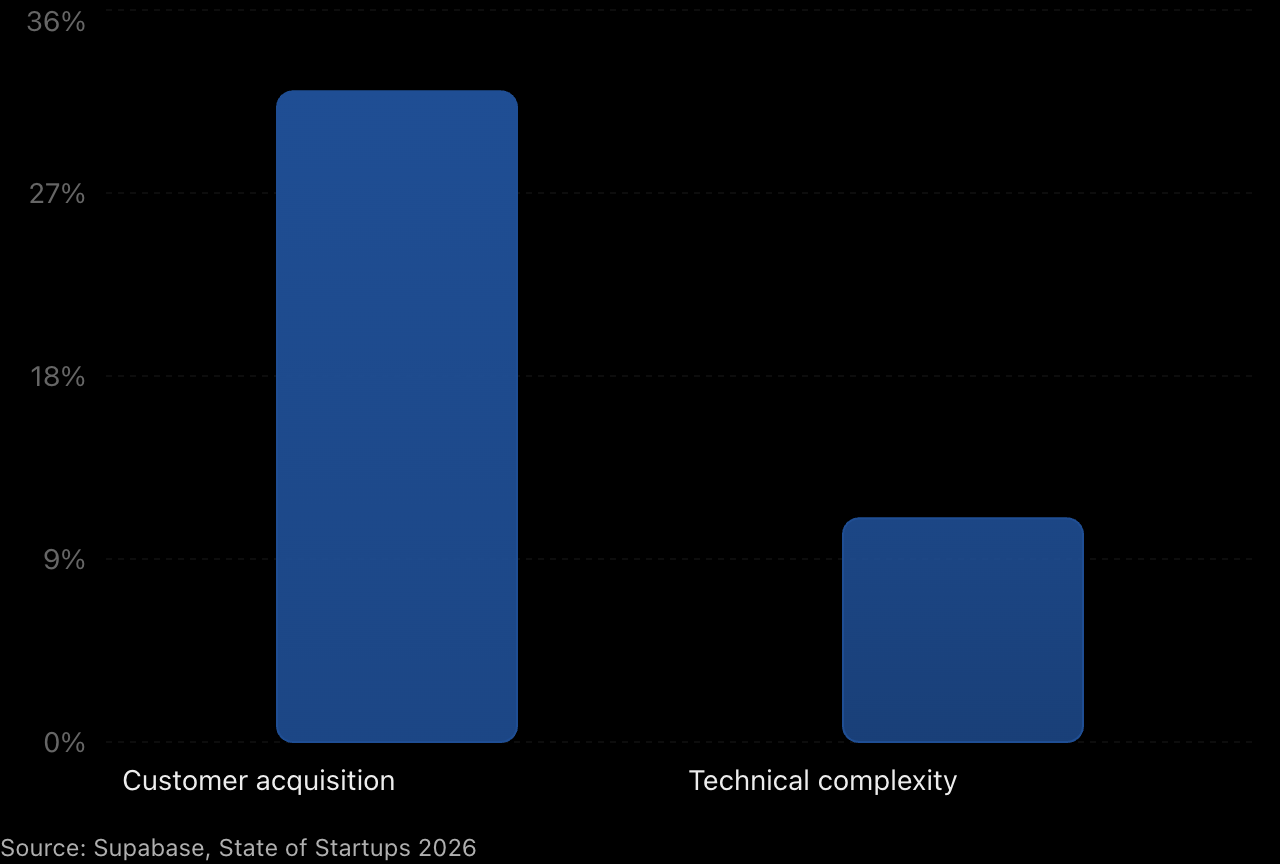
The survey also found that startups relying most heavily on AI generated code were less likely to be monetizing than those reporting no AI generated code.
That relationship deserves caution. It doesn’t prove AI generated software performs worse. Companies using these tools heavily may simply be younger, earlier in their development and still searching for a market.
But the broader lesson is difficult to miss.
Creating something people can use it not the same as creating something people want badly enough to pay for.
A founder can launch a beautiful travel planning app. That doesn’t explain why someone would choose it over Google Maps, and established booking platform, or an existing AI assistant.
An entrepreneur can build a wellness platform in days. That doesn’t automatically establish credibility, particularly when customers are being asked to trust a product with personal information.
AI can accelerate the development process. It cannot independently prove that a market exists.
When software become abundant, attention becomes scarce
An analysis published by web intelligence company Village in September identified more than 87,000 lives sites managed by five AI software building platforms.
Of those, only 682 appeared among the web’s one million most visited sites in the ranking data used for the study.
The findings aren’t a comprehensive measure of every AI built application, nor do they tell us which products are profitable. Some applications serve small valuable audiences and don’t need a mass traffic.
Still, the contrast illustrates an important point: making software available online is much easier than persuading people to discover and use it.
As the supply of applications increases, customers have more choices.
Founders must answer questions that a working prototype cannot resolve.
Who is the product for? What problem does it solve better than existing alternatives? How will customers discover it? Why should they trust it? And what will convince them to return?
These are business questions, not coding questions.
The value of relationships

One of the more surprising findings in Supabase’s research is how traditional the path to early customers remain.
Among surveyed startups, 56% identified personal or professional networks as a source of their initial paying customers. Cold outreach and sales followed at 35% while inbound social media accounted for 29%.
Even in a market increasingly shaped by automation, early revenue often begins with human relationships.
As we explored in AI is Making it Easier to Build. Getting into the Right Room is Another, the ability to create something is only pat of the equation. Access to the right people, relationships and opportunities can be just as imporatnt as the technology itself.
That could mean a founder showing a product to someone in their industry, asking a prospective customer about an inefficient workflow, or learning from a small group of early users.
It also helps explain why experience outside software development may become more valuable.
Someone who has spent years working in hospitality may understand a guest experience that a technically sophisticated developer overlooks.
A professional familiar with healthcare administration may recognize operational problems that would never appear in a generic list of startup ideas.
The opportunity isn’t simply to generate more products. It’s to combine faster development with knowledge of a problem, access to customers and the ability to earn their confidence.
Building a company is still different from building an app
There is another consequence of easier software creation.
If a product can be built quickly, competitors may be able to develop similar functionality quickly too.
Features alone may become less defensible. That advantage could shift toward customer relationships, proprietary information, operational expertise, brand recognition, distribution and the quality of the experience a company delivers.
For some businesses, AI will make it easier to launch without outside funding. For others, it will intensify competition and raise expectations about how quickly products improve.
Neither outcome guarantees success.
A founder still has to understand pricing, customer support, retention, legal obligations, operating costs and the economic of growth.
And as products mature, experienced engineers and other specialists may become more important, not less.
The next advantage may be knowing what not to build
The most consequential change in this new era of entrepreneurship may not be how quickly an idea becomes an application.
It may be how cheaply a founder can discover that an idea isn’t worth pursuing.
Instead of spending months developing something in isolation, entrepreneurs can test narrower ideas with real customers, learn where demand exists and change direction before committing significant resources.
That makes good judgment more valuable.
The strongest founders may not be the people who produce the greatest number of applications. They may be the one’s who understand a specific customer, identify an underserved need and build a business around solving it.
AI is changing the cost of creating software.
It has not eliminated the work of understanding people.
And in a world where almost anyone can build, knowing what deserves to be built amy become the greater advantage.
Sources and further reading